
· game
Scrap Station Defenders
Real-time strategy at two scales, where each one keeps the other running. Made in five days for the GMTK Game Jam 2024.
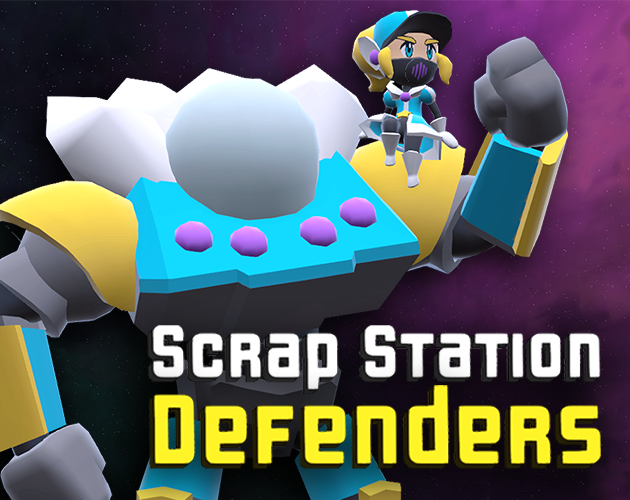
Real-time strategy inside and outside a giant mech.
- made: August 15–20, 2024
- for: GMTK Game Jam 2024 (theme: Built to Scale)
- team: five
- role: game design, UI, programming
- engine: Unity
- platform: browser (HTML5)
- status: shipped
Scrap Station Defenders was made in five days for the GMTK Game Jam 2024. The theme was "Built to Scale," and we took it literally: one game, played at two scales at the same time.
Inside the mech, you run a crew of android engineers, sending each one to a station. Press Tab and you're outside, commanding the mech itself on the battlefield. The enemies it destroys leave scrap behind. The scrap goes back inside, where it builds up the mech's systems. Better systems make a better mech, and a better mech brings back more scrap.
the loop
What I was excited about is that neither layer comes first. The mech can't move until someone inside sits down in the cockpit. The crew has nothing to build with until the mech goes out and wins something. Each scale is the reason the other one works.
Playing it, you end up juggling a task list that refers back to itself: staff the station so the mech can fight, so it can bring back scrap, so you can upgrade the station, so the mech can fight harder. When it clicks, you stop thinking of inside and outside as two games. They become one problem, seen at two zoom levels.
This is the thing I keep coming back to in design. You work inside one layer of a system, and you slowly realize that your layer is holding up the one above it, and the one above is holding up yours. Douglas Hofstadter calls that a strange loop. Scrap Station Defenders is a small, very literal one: two levels of a robot, folded into each other.
what we didn't finish
Five days wasn't enough to get it all the way to what we had in mind. The two layers work, but the loop between them needed more tuning than a jam allows. The game also doesn't tell you that the mech starts out empty, so at least one player sat outside clicking on a mech that wasn't going anywhere.
We're still proud of it. It's the cleanest picture I have of an idea I've been chasing ever since.
credits
- Matt Henry — game design, UI, programming
- Harrison Gardner — programming, modeling
- Jaron Frost — character modeling, animation, programming
- Ed Johnson — music
- Mark Stephenson — environment modeling